
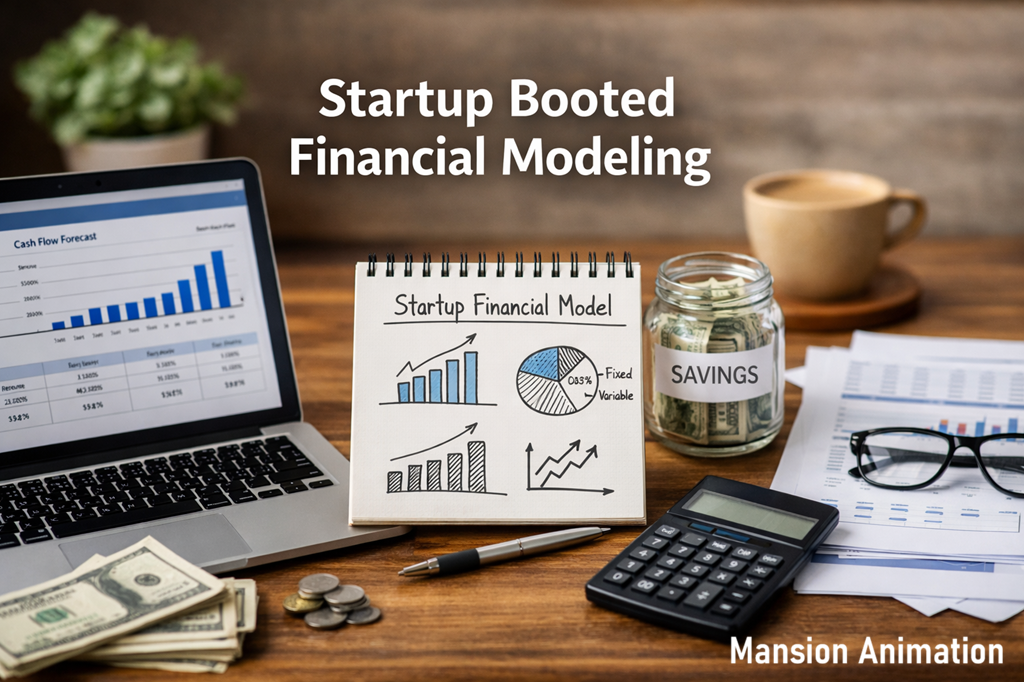
Startup booted financial modeling is a method of planning and forecasting a startup’s finances using revenue and personal funds instead of outside investment. It helps founders estimate income, expenses, cash flow, and runway so the business can grow sustainably without relying on investors.
A startup booted financial model usually includes:
- Revenue forecasts based on real customers
- Expense planning linked to income
- Cash flow projections
- Burn rate and runway tracking
- Break even calculations
- Key business metrics
This approach focuses on financial survival, steady growth, and disciplined spending. Instead of assuming future funding, the model assumes that revenue must support the business.
In simple terms, startup booted financial modeling is a financial roadmap that helps self funded startups stay stable and grow safely.
Understanding Booted Startups
A booted startup is a business that grows using its own financial resources.
Founders usually depend on:
- Personal savings
- Early customers
- Business revenue
- Small operating budgets
Because funding is limited, financial discipline becomes essential. Every expense must be planned and every decision must be based on numbers.
Startup booted financial modeling helps founders understand how money moves through the business and how long the company can operate with available funds.
Why Booted Financial Modeling Is Different
Booted startups operate under different conditions than investor funded companies. Growth depends on revenue instead of investment.
This difference changes how financial planning works.
Main Differences
| Area | Booted Startup | Funded Startup |
|---|---|---|
| Funding Source | Revenue and savings | Investors |
| Growth Strategy | Gradual growth | Fast scaling |
| Spending Approach | Controlled | Aggressive |
| Main Goal | Sustainability | Expansion |
| Financial Risk | Cash shortage risk | High burn risk |
Booted startups focus on financial stability first. Investor funded companies often focus on market growth first.
Revenue First Financial Planning
Startup booted financial modeling follows a revenue first approach.
Instead of planning growth around funding rounds, growth is planned around real income.
Revenue first planning includes:
- Conservative revenue forecasts
- Careful spending decisions
- Profit reinvestment
- Measured growth
- Financial safety margins
This approach helps founders avoid risky decisions.
When revenue drives growth, businesses become more stable.
Core Components of Startup Booted Financial Modeling
A reliable financial model includes several essential parts. Each part helps founders understand the business clearly.
Revenue Forecasting
Revenue forecasting estimates future income.
Forecasts should be based on measurable factors such as:
- Pricing
- Number of customers
- Monthly growth
- Retention rate
- Sales channels
Breaking revenue into smaller drivers makes forecasts more realistic.
For example:
- 25 customers per month
- Price 40 dollars
- Monthly revenue 1000 dollars
Small realistic estimates create better planning.
Cost Structure Planning
Understanding costs is essential for booted startups.
Expenses usually fall into two categories.
Fixed Costs
Fixed costs stay stable each month.
Examples include:
- Software tools
- Hosting services
- Core salaries
- Basic operations
Variable Costs
Variable costs increase with business activity.
Examples include:
- Marketing
- Payment processing fees
- Shipping costs
- Production costs
Separating fixed and variable costs helps founders manage risk.
Flexible cost structures improve stability.
Cash Flow Forecasting
Cash flow forecasting tracks how money enters and leaves the business.
A clear forecast usually includes:
- Monthly income
- Monthly expenses
- Remaining cash balance
For booted startups, managing available cash is often more important than tracking profit. Even profitable businesses can struggle if cash is not available when bills are due.
A business can show profit but still run out of cash if payments arrive late.
Monthly cash projections help founders detect problems early.
Runway and Burn Rate
Runway and burn rate measure financial survival.
Burn Rate
Burn rate shows how much money the startup spends each month.
Runway
It shows how long the startup can survive with available funds.
Runway Calculation
Runway = Available Cash ÷ Monthly Burn
Example:
- Cash 12,000 dollars
- Monthly burn 1,000 dollars
Runway equals 12 months.
Runway tracking helps founders plan safely.
Break Even Analysis
Break even analysis shows when revenue equals expenses.
At break even:
- The business covers its costs
- The business stops losing money
Knowing the break even point helps founders set clear goals.
Break even provides a target for financial stability.
Margin Protection Strategy
Margins protect startups from unexpected problems.
A margin buffer helps manage:
- Revenue drops
- Unexpected costs
- Market changes
Many founders keep several months of operating expenses as a reserve.
This improves long term stability.
Key Metrics Founders Should Track
Startup booted financial modeling depends on practical metrics that reflect real performance.
Important Metrics
| Metric | Purpose |
|---|---|
| Burn Rate | Measures monthly spending |
| Runway | Measures survival time |
| Break Even | Shows stability point |
| Profit Margin | Shows efficiency |
| CAC | Cost to acquire customers |
| LTV | Long term customer value |
Customer acquisition cost helps founders understand marketing performance.
Lifetime value shows total revenue generated by a customer.
A business model is usually healthy when customer value is higher than acquisition cost.
Building a Startup Booted Financial Model Step by Step
Startup booted financial modeling works best when built carefully.
Step 1 Create an Assumptions Sheet
The assumptions sheet contains:
- Pricing
- Customer growth
- Marketing costs
- Operating costs
This sheet allows easy changes and testing.
Step 2 Forecast Revenue Carefully
Revenue forecasts should be conservative.
Use:
- Real sales data
- Real conversion rates
- Real customer behavior
Realistic assumptions reduce risk.
Step 3 Build Monthly Cash Forecasts
Monthly forecasts should include:
- Starting cash
- Revenue
- Expenses
- Ending cash
Monthly tracking gives better control.
Most booted startups use 12 to 18 month forecasts.
Step 4 Connect Spending to Revenue
Spending should increase only when revenue grows.
Examples include:
- Increasing marketing after profit improves
- Hiring after stable revenue
- Expanding operations after break even
This approach protects financial stability.
Step 5 Update the Model Regularly
Financial models must be updated regularly.
Monthly updates should include:
- Actual revenue
- Actual expenses
- Updated forecasts
Regular updates improve accuracy.
Common Mistakes in Startup Booted Financial Modeling
Many founders make avoidable mistakes.
Overestimating Revenue
Unrealistic revenue expectations create financial risk.
Conservative projections are safer.
Ignoring Customer Acquisition Costs
Customer acquisition cost must be tracked.
Without CAC tracking, marketing spending becomes unpredictable.
Hiring Too Early
Early hiring increases fixed costs.
Booted startups should hire only when revenue is stable.
Confusing Profit With Cash
Profit does not always mean available money.
Delayed payments can create cash shortages.
Planning Only Best Case Scenarios
Strong financial models include conservative scenarios.
Worst case planning improves stability.
Recommended Structure of a Booted Financial Model
A practical financial model usually includes the following sections:
- Assumptions sheet
- Revenue forecast
- Expense forecast
- Cash flow statement
- Profit projection
- Runway calculation
- Break even analysis
This structure keeps the model organized and easy to update.
When Booted Financial Modeling Works Best
Startup booted financial modeling works best for businesses that can generate revenue early.
Examples include:
- Software startups
- Digital products
- Online services
- Ecommerce businesses
- Consulting startups
It may be less suitable for businesses that require large upfront investment such as manufacturing or research heavy industries.
Long Term Value for Founders
Startup booted financial modeling creates strong financial habits.
Over time founders gain:
- Better financial understanding
- Strong decision making
- Lower financial risk
- Stable growth
- Business clarity
Financial clarity also reduces uncertainty and improves confidence.
Conclusion
Startup booted financial modeling is a practical method for planning and managing a self funded startup. It helps founders understand revenue, expenses, and cash flow while planning safe growth.
By turning business ideas into financial forecasts, founders gain control over their decisions. Careful financial planning supports stability and long term success.
For self funded startups, startup booted financial modeling is one of the most important tools for building a sustainable business.